September 29, 2026
Four Circular RNA Targets in One RT-PCR Panel for Major Depressive Disorder: circATF7IP, circDYM, circPARN and circZBTB25 in Plasma and Saliva
Summary — Major depressive disorder is currently diagnosed by clinical interview and rating scale, which means that two people with the same HAMD-24 score can be in entirely different biological states, and neither the patient nor the clinician can see which one they are in. A real-time fluorescent RT-PCR assay that quantifies four circular RNA transcripts — circATF7IP, circDYM, circPARN and circZBTB25 — in plasma or saliva is an attempt to put a measurable number underneath that conversation. Circular RNA is unusually well suited to the task: it is covalently closed, resistant to exonuclease degradation, highly enriched in neural tissue, and stable enough to be read from a peripheral blood or saliva sample. Two of the four targets already have peer-reviewed support in the depressive-disorder literature, one being reported as elevated and one as reduced in the blood of people with MDD; for the remaining two, no PubMed-indexed report of a depression association was retrievable at the time of writing, and that gap is stated plainly in this article rather than glossed over. Against a DSM-5-based clinical reference standard across two multi-centre cohorts totalling 753 valid samples, the developer's clinical dossier records positive agreement of 99.8%, negative agreement of 87.1% and total agreement of 94.0%, with a pooled Kappa consistency coefficient of 0.878; those figures come from the developer's own dossier and are not independently peer reviewed. The workflow needs no new sampling procedure, no tissue biopsy and no purpose-built instrument: a standard real-time PCR platform carrying FAM, ROX and Cy5 channels is sufficient, and the whole chain from specimen to severity classification is four steps.
Key facts at a glance
- What it measures. The relative expression of four circular RNA transcripts — circATF7IP, circDYM, circPARN and circZBTB25 — read as cycle threshold (Ct) values by real-time fluorescent RT-PCR.
- Specimens. Plasma from not less than 3 mL of venous blood drawn into an EDTA tube, or at least 2 mL of saliva. Both are peripheral, non-invasive matrices; neither requires tissue biopsy or lumbar puncture.
- Platform. Any real-time PCR instrument carrying FAM, ROX and Cy5 fluorescence channels. No proprietary analyser is required.
- Panel architecture. Four targets distributed across two detection channels, with two independent internal controls (IC-A and IC-B) occupying the middle channel so that amplification failure stays separable from a true signal.
- Output. A quantitative depression score mapped to three severity bands: Normal (below 20), Mild to Moderate (20 to 35) and Severe (above 35). Band direction is aligned with the rating scales psychiatrists already use.
- Workflow. Four steps — specimen collection, column-based circRNA extraction, real-time RT-PCR amplification, and software-assisted scoring with a structured patient report.
- Intended use. Adjunct screening, diagnostic support and severity assessment in major depressive disorder, and longitudinal monitoring of treatment response. It is not a stand-alone diagnostic and does not replace clinical assessment.
- Clinical dossier performance. 753 valid samples across two multi-centre cohorts: positive agreement 99.8% (411/412), negative agreement 87.1% (297/341), total agreement 94.0% (708/753), pooled Kappa 0.878. Developer's dossier, not peer reviewed.
- Peer-reviewed benchmark. The strongest directly comparable PubMed-indexed figure for a single plasma circRNA in MDD is an AUC of 0.796 with 97.9% specificity and 60.4% sensitivity (PMID 38065380).
- Evidence tiers are labelled throughout. Every performance number in this article is tagged either as peer-reviewed literature with a PMID, or as the developer's clinical dossier. The two are never mixed.
The clinical problem: a diagnosis assembled from conversation and questionnaire
Depressive disorders sit among the largest contributors to years lived with disability worldwide, and the Global Burden of Disease Study 2021 quantified that burden across 204 countries and territories (PMID 38642570). The equivalent analysis for China and its provinces over 1990 to 2021 reported the same pattern at national and subnational level (PMID 39838265). The scale of the problem is not in dispute. What remains in dispute is how to measure it.
The United States Preventive Services Task Force recommends screening adults for depression, and its 2023 recommendation statement is unambiguous that the condition is common and under-detected (PMID 37338872). But the instruments the recommendation rests on are questionnaires. An individual participant data meta-analysis of the Patient Health Questionnaire-9 across screening studies established that a questionnaire is a reasonable screening filter and a poor substitute for a measurement (PMID 30967483). A questionnaire returns a number that describes what a person reports, not what their biology is doing.
Treatment selection inherits the same uncertainty. A network meta-analysis of 21 antidepressant drugs for acute treatment in adults found that all of them outperformed placebo, while differences between drugs were modest (PMID 29477251). When a clinician cannot see a baseline biological state, the first months of treatment become an experiment conducted on the patient, and switching decisions are made from symptom report alone.
Molecular psychiatry has been trying to close that gap for two decades, and it is worth being candid about how far it has actually come. A systematic evaluation of machine-learning-based biomarkers for major depressive disorder, published in JAMA Psychiatry in 2024, examined the published literature and found that reported performance did not survive rigorous cross-validation and replication (PMID 38198165). That result does not discredit the search for a biomarker. It sets the bar. Any new depression marker should be described with its evidence tier attached, and any claim that exceeds what has been replicated should be withdrawn before it is printed.
Why circular RNA is a workable molecule for a routine laboratory test
Circular RNAs are generated by back-splicing, which joins a downstream splice donor to an upstream splice acceptor and produces a covalently closed loop rather than a linear transcript. Two consequences matter for diagnostics. First, the closed loop has no free ends, so it resists exonuclease digestion and survives far longer in a stored specimen than linear RNA of comparable abundance. Second, circRNAs are highly enriched in neural tissue and are detectable in peripheral blood and saliva, which means a brain-relevant molecular signal can be read from an arm, not from a biopsy.
Both properties are now well documented in the review literature. A 2021 review in Biomedicine & Pharmacotherapy set out circRNA biogenesis, function and expression in depression and assessed their therapeutic potential (PMID 33493967). A 2025 review in Molecular Psychiatry surveyed computational identification, functional validation and clinical applications of circRNAs across neuropsychiatric and neurodegenerative conditions, noting their evolutionary conservation, stability and high expression in neural tissue (PMID 39966624). An earlier review specifically compared circRNA findings in schizophrenia and depression (PMID 32457667), and a 2025 scoping review in The Journal of Neuropsychiatry and Clinical Neurosciences examined how far circRNAs have actually reached neuropsychiatric practice and which clinical needs remain unmet (PMID 40384036).
The mechanistic evidence in depression is specific rather than generic. circDYM was shown to act as an endogenous microRNA-9 sponge, raising HECTD1 and increasing HSP90 ubiquitination, which in turn dampened microglial activation (PMID 30413800). circHIPK2 was linked to the gut microbiota–astrocyte axis in a mouse model, with faecal microbiota transplantation from NLRP3-deficient animals ameliorating depressive-like behaviour through circHIPK2 inhibition (PMID 31439031). circSTAG1 was reported to regulate astrocyte dysfunction through N6-methyladenosine modification of fatty acid amide hydrolase messenger RNA (PMID 32387133). More recently, microglial circ-UBE2K was found to exacerbate depression by regulating its parental gene through HNRNPU (PMID 38994030), and circPTK2 was associated with depressive-like behaviour through miR-182-5p (PMID 38266777). These studies are mechanistic and largely preclinical, but they establish that individual circRNAs are not incidental passengers in depression biology.
The four targets, and what each one's evidence actually shows
The panel is built from four circRNA transcripts. Their public evidence is not equal, and the difference is material to anyone evaluating the kit, so each target is presented here with its own evidence status.
circATF7IP — reported elevated in MDD plasma, and correlated with symptom severity
A 2024 study in Advanced Healthcare Materials reported that circATF7IP is significantly upregulated in plasma samples from people with major depressive disorder and positively correlated with 24-item Hamilton Depression Rating Scale (HAMD-24) scores. In the same work, intranasal delivery of lipid nanoparticles carrying siRNA against circATF7IP reduced the CD11b-positive CD45-dim microglial population and lowered the pro-inflammatory cytokines TNF-α and IL-6 in an LPS-induced mouse model, alleviating depressive-like behaviour (PMID 39254274). The plasma finding gives the marker a human direction of change and a severity correlation; the interventional arm gives it a plausible mechanism. It does not give it a validated diagnostic cut-off. For completeness, a separate publication reports circ-ATF7IP acting through miR-488-3p in papillary thyroid carcinoma (PMID 40945694), which is unrelated to depression and is noted only to make clear that the transcript is not exclusively neural.
circDYM — reported reduced in MDD blood, and responsive to treatment
circDYM has the deepest evidence base of the four. It was first reported to be significantly decreased both in the peripheral blood of patients with MDD and in two depressive-like mouse models, with restoration attenuating depressive-like behaviour and inhibiting microglial activation, through the miR-9–HECTD1–HSP90 axis described above (PMID 30413800). A clinical study in Journal of Affective Disorders then recruited 60 patients with MDD and 32 normal controls, found baseline plasma circDYM significantly lower in the MDD group (p equals 0.030), and reported positive correlations with HAMD-24 total score (r equals 0.318, p equals 0.031) and with the retardation subscale (r equals 0.323, p equals 0.029). After five consecutive days of real visual-cortical repetitive transcranial magnetic stimulation, circDYM rose significantly (p equals 0.006); after sham treatment it did not (p equals 0.170) (PMID 32663980). A further study showed that extracellular-vesicle-mediated delivery of circDYM alleviated chronic-unpredictable-stress-induced depressive-like behaviour (PMID 35029057).
That cluster of findings matters for two reasons. It gives the panel a marker whose direction of change in human plasma has been observed independently, and its treatment-responsiveness is the direct published precedent for using a circRNA panel to monitor antidepressant interventions rather than only to screen.
circPARN and circZBTB25 — rationales, not literature
The remaining two panel members are presented without a literature claim, because none could be found. A systematic PubMed search performed at the time of writing returned no indexed publication reporting an association between circPARN and depression, and none between circZBTB25 and depression. Searches on the parent genes return the expected non-psychiatric literature and nothing psychiatric: PARN encodes a poly(A)-specific ribonuclease central to mRNA deadenylation and transcript turnover, while ZBTB25 encodes a POZ/zinc-finger transcription factor with E3 ubiquitin ligase activity. Both are plausible nodes in the RNA-processing and ubiquitin pathways that the depression circRNA literature already implicates, and the developer reports an internal discovery dataset supporting their inclusion.
This article states that position explicitly rather than attaching them to citations that do not exist. circATF7IP and circDYM have retrievable PubMed support in depressive disorders; circPARN and circZBTB25 do not, as of the date of writing. Readers evaluating the panel should treat the first two as literature-supported markers and the second two as proprietary panel components whose justification rests on the developer's clinical dossier and is not yet independently peer reviewed.
The design logic of combining them is nonetheless coherent and is worth stating, because it is testable. circDYM is reported to fall in MDD and circATF7IP to rise; a panel that contains at least one marker moving in each direction is less vulnerable to a single assay artefact flipping the output. Adding targets also dilutes the effect of individual variation in any one transcript, which is the standard argument for a multi-marker signature over a single-marker test. It is an argument, not a result. The independent replication that would settle it has not yet been published.
Assay design, workflow and specimen logistics
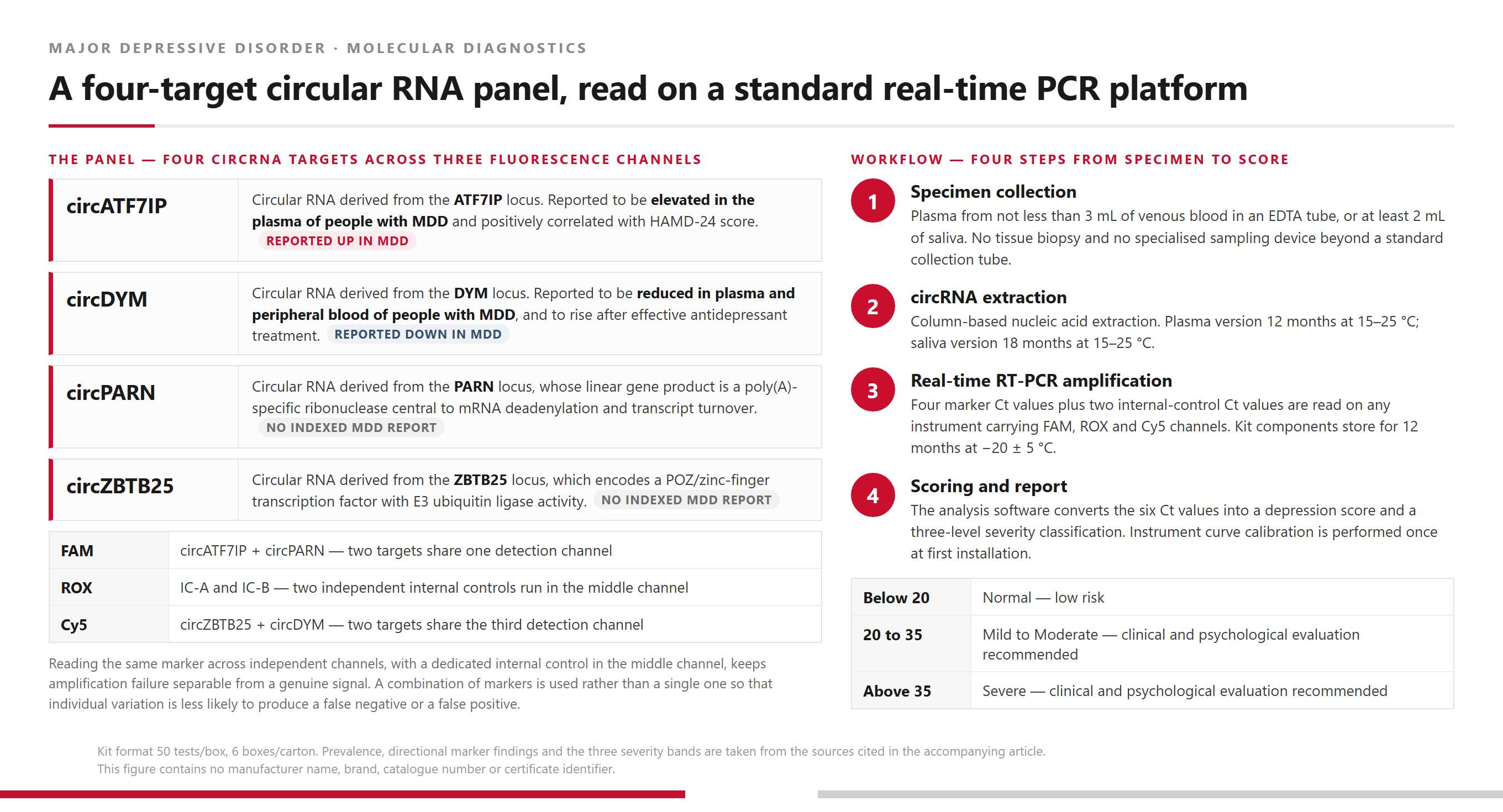
The panel runs across three fluorescence channels. circATF7IP and circPARN are read in the FAM channel; IC-A and IC-B, the two internal controls, occupy the ROX channel; circZBTB25 and circDYM are read in the Cy5 channel. Placing the internal controls in the middle channel, between the two target channels, is what keeps extraction or amplification failure separable from a genuinely low or absent target signal — a design requirement in any assay intended to report a negative result as a result rather than as an absence of information.
The workflow is four steps and does not require the laboratory to build a method from scratch.
- Step 1 — Specimen collection. For the plasma version, collect not less than 3 mL of venous blood into an EDTA anticoagulant tube and centrifuge at 1000 × g for 15 minutes to obtain plasma; transfer the upper plasma layer to a fresh tube. Whole blood should be processed immediately; where that is not possible it holds for 6 hours at room temperature or 24 hours at 2 to 8 °C, and must not be frozen. For the saliva version, rinse the mouth with water and collect at least 2 mL of saliva 30 minutes later, then centrifuge twice at 4 °C to obtain supernatant.
- Step 2 — circRNA extraction. Column-based nucleic acid extraction using the supplied spin columns. The plasma extraction kit stores for 12 months at 15 to 25 °C, with the spin columns held separately at 2 to 8 °C; the saliva extraction kit stores for 18 months at 15 to 25 °C.
- Step 3 — Real-time RT-PCR amplification. Four target Ct values and two internal-control Ct values are generated in a single run on any instrument with FAM, ROX and Cy5 channels. The amplification kit stores for 12 months at minus 20 plus or minus 5 °C and includes both a positive and a negative control.
- Step 4 — Scoring and report. Patient and specimen information are registered, the six Ct values entered, and the analysis software returns a depression score with its severity classification, then generates a structured patient report carrying patient information, specimen information, the four target Ct values and the final score.
Specimen stability is a practical rather than a theoretical constraint, and it is documented in full. Plasma holds for 3 months at minus 20 °C or 12 months at minus 70 °C. Saliva is usable immediately or for 72 hours at 2 to 8 °C, then 3 months at minus 20 °C or 12 months at minus 70 °C. Plasma, saliva and saliva supernatant should not be subjected to more than three freeze–thaw cycles. The allowance for 6 hours at room temperature on whole blood matters more than it looks: it means a collection point without an on-site centrifuge can draw a sample and ship it, which is the difference between a test that stays inside a tertiary hospital and one that can serve a screening programme.
One delivery prerequisite should be confirmed before quotation rather than after installation. Because the scoring algorithm is matched to the instrument, the end laboratory must report the brand and model of its PCR instrument and the three fluorescence channels it will use. At first installation the instrument is curve-calibrated with supplied standard materials, the calibration data is returned, and the scoring algorithm is customised and delivered as an installation package for that specific instrument. The software is supplied on a USB drive or over the internet, licensed to a single instrument, available in multiple languages, and updated free of charge on a long-term basis. That calibration step is a one-off cost; every subsequent specimen adds reagent and consumable cost only.
Analytical performance: what is documented, and what must be requested
This article does not quote limits of detection, repeatability, linearity or interference figures for the assay, because those values are held in the manufacturer's Instructions for Use and performance evaluation report rather than in a peer-reviewed publication, and no source available to this article states them. What can be stated from the available documentation is the set of analytical design facts that a laboratory would check first:
- Two internal controls per reaction. IC-A and IC-B run in a dedicated channel, so extraction failure, inhibition and amplification failure are distinguishable from a true low signal.
- Positive and negative controls supplied in the kit. Both run alongside each batch of specimens.
- Three-channel compatibility. FAM, ROX and Cy5 only, which is the most widely available channel set on installed real-time PCR instruments and avoids locking the laboratory into one vendor's platform.
- Documented specimen stability windows. Whole blood 6 hours at room temperature or 24 hours at 2 to 8 °C; plasma 3 months at minus 20 °C; saliva 72 hours at 2 to 8 °C; and a stated freeze–thaw ceiling of three cycles for plasma, saliva and supernatant.
- Documented reagent shelf life. 12 months at minus 20 plus or minus 5 °C for the amplification kit, 12 months at 15 to 25 °C for the plasma extraction kit with spin columns at 2 to 8 °C, and 18 months at 15 to 25 °C for the saliva extraction kit.
The distinction between analytical and clinical performance is not pedantic here. Analytical performance tells a laboratory whether the assay behaves reproducibly on their bench. Clinical performance tells a clinician whether the number means anything about a patient. Laboratories evaluating this kit for accreditation should request the full performance evaluation report and assess it against their own validation requirements, and should not treat the clinical agreement figures below as a substitute for it.
Clinical performance: agreement with the clinical reference standard
The developer's clinical dossier records two multi-centre cohorts and one pooled analysis. All figures below are reproduced exactly as stated in that dossier and are not independently peer reviewed.
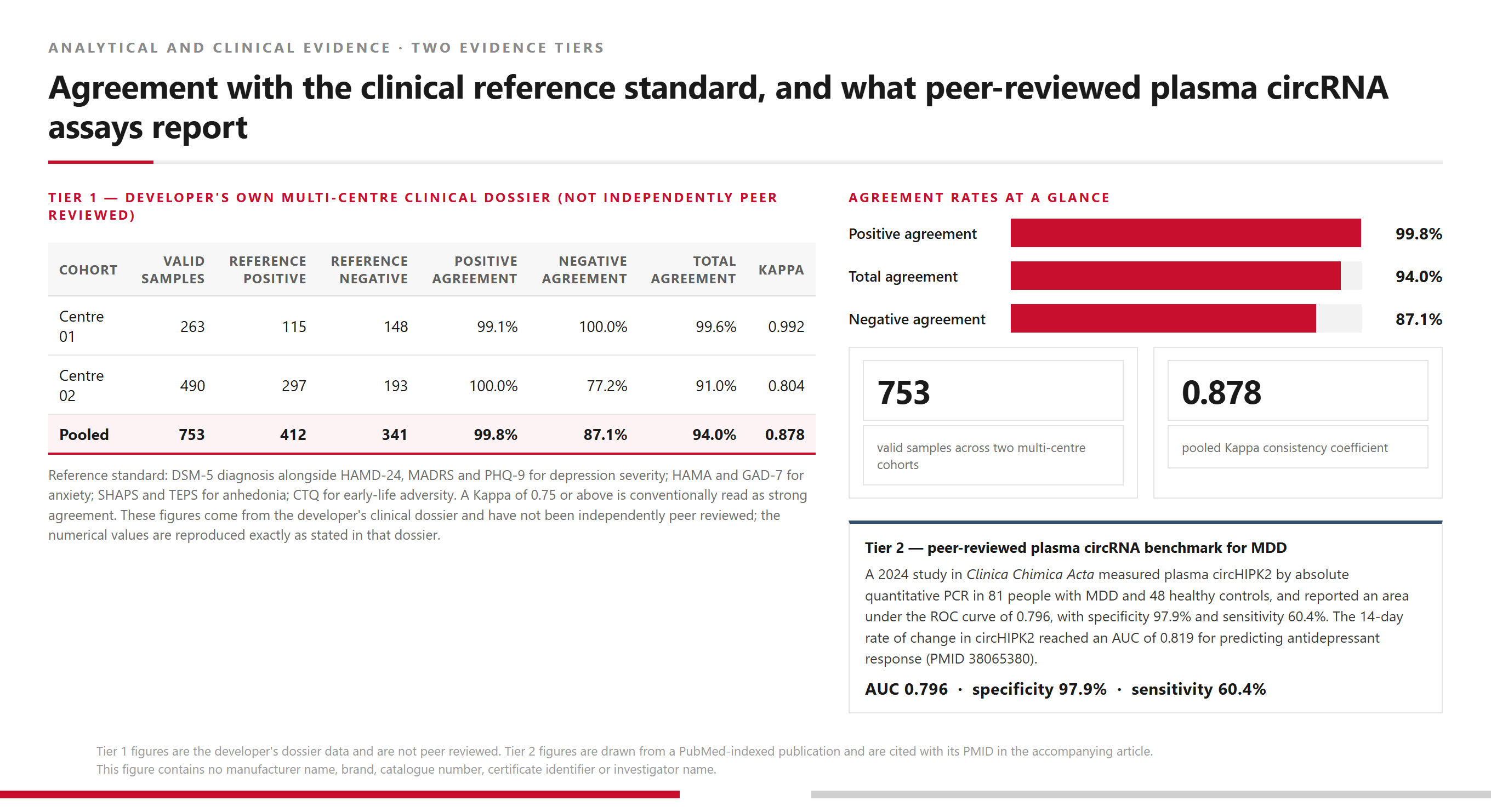
| Cohort | Valid samples | Reference positive | Reference negative | Positive agreement | Negative agreement | Total agreement | Kappa |
|---|---|---|---|---|---|---|---|
| Centre 01 | 263 | 115 | 148 | 99.1% (114/115) | 100.0% (148/148) | 99.6% (262/263) | 0.992 |
| Centre 02 | 490 | 297 | 193 | 100.0% (297/297) | 77.2% (149/193) | 91.0% (446/490) | 0.804 |
| Pooled | 753 | 412 | 341 | 99.8% (411/412) | 87.1% (297/341) | 94.0% (708/753) | 0.878 |
The reference standard in both cohorts was diagnosis against DSM-5 criteria, supported by a structured battery: HAMD-24, MADRS and PHQ-9 for depression severity; HAMA and GAD-7 for anxiety severity; SHAPS and TEPS to assess the presence and severity of anhedonia; and CTQ to capture early-life adversity. Cohort 01 contributed 263 valid samples with 115 reference-positive and 148 reference-negative results. Cohort 02 contributed 490 valid samples with 297 reference-positive and 193 reference-negative results. Pooled across both, 412 samples were reference-positive and 341 reference-negative. These figures are the developer's dossier data and are not peer reviewed.
Two features of the numbers deserve attention rather than a headline. First, the two cohorts behaved differently. Cohort 01 recorded 99.1% positive agreement, 100.0% negative agreement, 99.6% total agreement and a Kappa of 0.992, while cohort 02 recorded 100.0% positive agreement but 77.2% negative agreement, 91.0% total agreement and a Kappa of 0.804. A panel that finds every true case but over-calls roughly one in five unaffected people in a larger cohort is behaving like a sensitive screening tool and not like a confirmatory test, and the negative agreement figure — not the positive one — is where the pooled 87.1% comes from. Second, the pooled Kappa of 0.878 indicates strong agreement with the reference standard by the conventional threshold of 0.75, but Kappa is a measure of agreement and not of accuracy: it depends on the prevalence of the condition in the sample, and both cohorts were enriched for depression relative to a general screening population. A laboratory deploying this assay into a low-prevalence screening programme should expect different predictive values from the ones reported here, and should assess that question locally rather than assuming the dossier figures transfer.
Two further components of the dossier are reported qualitatively and are flagged as such. A treatment-monitoring study recorded that patients who underwent 10 to 20 sessions of transcranial magnetic stimulation showed a significant decrease in panel result relative to their own pre-treatment baseline, with a trend consistent with the clinical reference standard; the study is described as ongoing, with data after the 40th treatment session still to be collected, and no numerical effect size is quoted in the source material available. A paired plasma–saliva concordance analysis is also reported; the concordance metrics are held in the dossier and should be requested directly with the full clinical study report, because this article was not able to reconcile them to a single stated value across the available source documents.
Peer-reviewed evidence retrievable on PubMed
Separately from the developer's dossier, there is a substantial and growing peer-reviewed literature on circRNAs as peripheral biomarkers in depressive disorders. The following is what that literature reports, with PMIDs so that every statement can be verified independently. Grouped by what the study actually did.
| Marker and matrix | Study population | Reported performance | Source |
|---|---|---|---|
| Plasma circHIPK2, absolute quantitative PCR | 81 patients with MDD and 48 healthy controls | AUC 0.796; specificity 97.9%; sensitivity 60.4% | PMID 38065380 |
| 14-day rate of change in plasma circHIPK2 | Same cohort, followed for 14 days | AUC 0.819 for predicting antidepressant effect | PMID 38065380 |
| Plasma circDYM | 60 patients with MDD and 32 normal controls | Significantly lower in MDD (p equals 0.030); positive correlation with HAMD-24 total (r equals 0.318, p equals 0.031) and retardation subscale (r equals 0.323, p equals 0.029); rose after real rTMS (p equals 0.006) but not sham (p equals 0.170) | PMID 32663980 |
| Peripheral blood circRNA panel: hsa_circ_0002473, hsa_circ_0079651, hsa_circ_0137187, hsa_circ_0006010, hsa_circ_0113010 | MDD patients versus controls | Five transcripts reported highly expressed in MDD blood and proposed as diagnostic markers; four implicated in a competing-endogenous-RNA mechanism affecting neuroplasticity | PMID 35431783 |
Plasma circRNA as a diagnostic and predictive marker in MDD
- A 2024 study in Clinica Chimica Acta measured plasma circHIPK2 by absolute quantitative PCR in 81 patients with MDD and 48 healthy controls. circHIPK2 was significantly increased in the MDD group, with an area under the ROC curve of 0.796, specificity 97.9% and sensitivity 60.4%. The 14-day rate of change in circHIPK2 reached an AUC of 0.819 for predicting antidepressant effect (PMID 38065380).
- The Journal of Affective Disorders study described above established reduced baseline plasma circDYM in MDD, its correlation with HAMD-24 total and retardation subscores, and its significant increase after real but not sham visual-cortical rTMS (PMID 32663980).
- A study in Frontiers in Neuroscience reported disordered circRNA expression in the blood of MDD patients and identified five transcripts — hsa_circ_0002473, hsa_circ_0079651, hsa_circ_0137187, hsa_circ_0006010 and hsa_circ_0113010 — as candidate diagnostic markers, with bioinformatic evidence that four of them may act through a competing-endogenous-RNA mechanism affecting neuroplasticity (PMID 35431783).
Mechanistic and interventional studies in depressive models
- circDYM acting as a miR-9 sponge, raising HECTD1 and increasing HSP90 ubiquitination to suppress microglial activation (PMID 30413800), and extracellular-vesicle-mediated circDYM delivery alleviating stress-induced depressive-like behaviour (PMID 35029057).
- circATF7IP upregulated in MDD plasma and correlating with HAMD-24, with intranasal lipid-nanoparticle siRNA knockdown reducing microglial activation and pro-inflammatory cytokines in an LPS model (PMID 39254274).
- circHIPK2 as the mediator through which gut microbiota from NLRP3-deficient mice ameliorated depressive-like behaviour via astrocyte function (PMID 31439031).
- circSTAG1 regulating astrocyte dysfunction through m6A modification of fatty acid amide hydrolase messenger RNA and modulating depressive-like behaviours (PMID 32387133).
- Microglial circ-UBE2K exacerbating depression by regulating its parental gene UBE2K through HNRNPU (PMID 38994030).
- circPTK2 associated with depressive-like behaviours through miR-182-5p (PMID 38266777).
Treatment-response and treatment-effect monitoring
- Blood-based circRNA and miRNA biomarkers were associated with modified electroconvulsive therapy efficacy and with memory impairment in MDD, with a circRNA–miRNA regulatory network correlating with multiple clinical symptom and memory scores (PMID 41239965).
- Plasma circDYM increased after real rTMS but not sham treatment, and the 14-day rate of change in plasma circHIPK2 predicted antidepressant effect with an AUC of 0.819 (PMID 32663980; PMID 38065380).
Reviews and assessments of the field
- circRNA biogenesis, function, expression and therapeutic potential in depression (PMID 33493967).
- Computational identification, functional validation and clinical applications of circRNAs in neurological conditions (PMID 39966624).
- circRNA findings compared across schizophrenia and depression (PMID 32457667).
- A scoping review of circRNA in neuropsychiatric practice and the unmet clinical needs that remain (PMID 40384036).
- A systematic evaluation concluding that machine-learning-based biomarkers for MDD have not yet survived cross-validation and replication (PMID 38198165).
How to read this evidence honestly
The published single-marker plasma circRNA studies for MDD cluster in a recognisable range: areas under the ROC curve of roughly 0.7 to 0.8, with specificity routinely above 90% and sensitivity markedly lower, in the region of 60%. High specificity with modest sensitivity is the signature of a marker that is useful for ruling in and unreliable for ruling out. The four-target panel is, in effect, a design hypothesis that adding markers will raise sensitivity without losing specificity. That hypothesis is reasonable on first principles and completely unproven in the public literature, because the panel's own clinical data has not yet been published in a peer-reviewed journal. Any reader who takes away one number from this article should take away that one, and should watch for the independent replication rather than assume it.
It should also be noted that several of the mechanism studies cited above were conducted by research groups that work closely with the panel's originator, and the circDYM and circATF7IP clinical studies originate from institutions in the same clinical network. That does not invalidate the findings, which are published in peer-reviewed journals on their own merits, but it does mean the evidence base is not fully independent of the product it supports. Publishing the panel's own prospective clinical data in a peer-reviewed journal would be the single most valuable thing that could be done for this product's credibility, and the absence of that publication is the most significant limitation in this article.
Clinical use scenarios
- Objective first-line screening where detection rates are low. In settings where depression screening depends entirely on questionnaires, a laboratory result gives the clinician a second, non-self-reported axis for deciding who needs a full psychiatric assessment. The high positive agreement in the dossier supports this use; the lower negative agreement argues against using the result alone to exclude.
- Difficult differential diagnosis. Where symptoms overlap with anxiety, adjustment disorder, bipolar depression or somatic illness, or where a patient's reported severity and observed function do not match, a quantitative marker can add information that the interview cannot generate.
- Treatment selection and monitoring. Establishing a biological baseline before starting pharmacotherapy, psychotherapy, transcranial magnetic stimulation or electroconvulsive therapy, then repeating the measurement at defined intervals, converts an otherwise invisible trajectory into a number. The published circDYM rTMS and circHIPK2 antidepressant-prediction data are the precedent for this use.
- Assessment in populations that under-report. Adolescents, perinatal and postpartum women, older adults and people in high-stress occupations frequently have their symptoms normalised by themselves or by those around them. A peripheral measurement removes the reporting step from the pathway.
- Population and institutional screening. Schools, employers, maternal health services and insurance programmes can run a plasma or saliva assay on existing real-time PCR capacity without building a new laboratory function. The 6-hour room-temperature whole-blood window and the absence of a proprietary instrument are what make this operationally feasible.
- Stratified enrolment and endpoint measurement in research. A quantitative circRNA panel can serve as a stratification variable for trial enrolment and as an objective endpoint in antidepressant and neuromodulation trials, where questionnaire-based endpoints remain a known weakness.
Who the test is intended for
Four populations carry the strongest case for objective measurement, and they share a common feature: in all four, the symptom is most likely to be rationalised rather than investigated.
- Adolescents and young adults. Academic pressure, relationship instability, disrupted sleep and social comparison are simultaneously the most common causes of low mood and the most common reasons for dismissing it. Global pooled prevalence estimates for depression and elevated depressive symptoms in adolescents (PMID 34569066) and in children and adolescents (PMID 38490591) both establish that the burden in this group is substantial and recurrent, and this is also the group least likely to present voluntarily.
- Perinatal and postpartum women. Hormonal fluctuation, family stress and the absence of preparation for the postpartum period combine with a strong social pressure not to report distress. A non-invasive peripheral test removes both the reporting barrier and the objection to pharmacological intervention during pregnancy and lactation that a questionnaire-based diagnosis can provoke.
- Older adults. Loneliness, reduced mobility, fear of illness and fear of death present as depression and are routinely attributed to age. Where polypharmacy and comorbidity make empirical antidepressant trials risky, a baseline objective measure has particular value.
- High-stress occupational groups. High-intensity work, heavy responsibility, irregular schedules and competitive pressure produce depressive symptoms in people who are professionally incentivised not to disclose them. Saliva sampling is specifically useful here, because it can be performed without a phlebotomist.
The test is not intended for stand-alone diagnosis, for use as the sole basis of any treatment decision, for children outside an appropriately governed research or specialist setting, or for routine use in asymptomatic populations without a defined pathway for what happens to a positive result. A screening test without a referral pathway creates anxiety without creating benefit.
What this test is not
This section exists because the fastest way to destroy a diagnostic product's credibility is to over-claim for it once.
- It is not a stand-alone diagnostic. The result supports a clinician's assessment. Major depressive disorder remains a clinical diagnosis, and the panel does not replace the interview, the rating scales or clinical judgement.
- Its clinical performance figures are not peer reviewed. The 99.8%, 87.1%, 94.0% and Kappa 0.878 figures come from the developer's clinical dossier. They have not been published in a peer-reviewed journal and have not been independently replicated.
- Its negative agreement is materially lower than its positive agreement. A pooled negative agreement of 87.1%, and 77.2% in the larger of the two cohorts, means a negative result does not exclude depression. A negative result in a symptomatic patient should not end the assessment.
- Two of the four targets have no retrievable PubMed literature in depression. circATF7IP and circDYM do. circPARN and circZBTB25 do not, as of the date of writing. Their inclusion rests on the developer's internal data.
- It is not a substitute for a validated severity scale in clinical decision-making. The three severity bands are aligned in direction with HAMD-24, MADRS and PHQ-9, but they are not interchangeable with them and should not be converted into them.
- It does not diagnose or exclude bipolar disorder, schizophrenia or anxiety disorders. The reference standard and the cited literature address major depressive disorder. Extrapolating the result to other psychiatric diagnoses is not supported.
- It does not predict suicide risk. Nothing in the cited literature supports that claim and this article makes it nowhere.
- Its analytical parameters are not published. Limit of detection, precision, linearity and interference data are held in the Instructions for Use and performance evaluation report and must be requested and reviewed independently before a laboratory adopts the assay.
- The treatment-monitoring evidence is preliminary. The dossier's TMS assessment study is described as ongoing, with post-40-session data outstanding, and reports a directional trend rather than a validated biomarker response definition.
Specifications, kit configuration and delivery
The product is delivered as three components, all at a specification of 50 tests per box and 6 boxes per carton.
- Nucleic acid extraction kit, plasma version. Contains Buffer × 4, DEPC water × 1, collection tubes × 50, 1.5 mL tubes × 50 and independently packaged spin columns × 50. Stores for 12 months at 15 to 25 °C; spin columns separately at 2 to 8 °C.
- Nucleic acid extraction kit, saliva version. Contains wash buffer × 2, lysis buffer, DEPC water, collection tubes × 150 and mini columns × 50. Stores for 18 months at 15 to 25 °C.
- CircRNA RT-PCR detection kit. Contains master mix × 2, primer sets × 2, positive control and negative control. Stores for 12 months at minus 20 plus or minus 5 °C and is compatible with instruments carrying FAM, ROX and Cy5 channels.
- Analysis software. Supplied on USB drive or over the internet, licensed to a single instrument, available in multiple interface languages, with free long-term updates. One-time instrument curve calibration is required at first installation.
The quality management position recorded in the product documentation is CE marking under IVDD 98/79/EC as an in-vitro diagnostic device, certification to ISO 13485:2016, and MDSAP and IVDR transition activity in progress. Certificate numbers and unique device identifiers are deliberately not reproduced here.
Frequently asked questions
What exactly does the four-target circRNA panel measure?
It measures the relative expression of four circular RNA transcripts — circATF7IP, circDYM, circPARN and circZBTB25 — as cycle threshold values from a real-time fluorescent RT-PCR run, using two internal controls to normalise the result. The software converts those six Ct values into a quantitative depression score.
Is this a screening test or a diagnostic test?
It is an adjunct test. It is intended for screening support, diagnostic support and severity assessment, and for monitoring treatment response. Major depressive disorder remains a clinical diagnosis, and the result is one input to that diagnosis rather than a replacement for it.
Should plasma or saliva be used?
Both are validated specimen types in the product documentation, and both are collected non-invasively. Plasma requires not less than 3 mL of venous blood in an EDTA tube and centrifugation; saliva requires at least 2 mL and two centrifugation steps. Saliva has a shorter room-temperature window and a 72-hour limit at 2 to 8 °C, which matters for logistics. A paired plasma–saliva concordance analysis is reported in the developer's dossier and the detailed concordance metrics should be requested with the full study report.
What laboratory equipment is needed?
A real-time PCR instrument with FAM, ROX and Cy5 fluorescence channels, a benchtop centrifuge, and standard molecular biology pipetting equipment. No proprietary analyser, no mass spectrometer and no sequencing platform is required. The end laboratory must report its instrument brand, model and the three channels it will use before order confirmation, so that the scoring algorithm can be matched to that instrument.
How long does the workflow take, and how many steps are there?
Four steps: specimen collection, column-based circRNA extraction, real-time RT-PCR amplification, and software-assisted scoring and reporting. The design intent is that a laboratory already running real-time PCR can adopt the assay without creating a new method from first principles. Turnaround time is bounded mainly by the extraction and amplification cycles of the laboratory's existing platform.
How is the depression score interpreted?
Three bands: below 20 is classified Normal, indicating low risk; 20 to 35 is classified Mild to Moderate, with clinical and psychological evaluation recommended; above 35 is classified Severe, with clinical and psychological evaluation recommended. The band directions align with the rating scales psychiatrists currently use, so a clinician does not have to relearn an interpretation convention.
Can the result replace the psychiatrist's clinical interview?
No, and it is not intended to. The interview and the rating scales capture functional impairment, history, context and risk, none of which a blood or saliva assay can see. The value of the panel is that it adds a quantitative, non-self-reported axis to an assessment that currently has only a self-reported one.
Can it be used to monitor treatment response?
That is one of its intended uses, and there is a peer-reviewed precedent for it: plasma circDYM rose significantly after real visual-cortical rTMS but not after sham treatment (PMID 32663980), and the 14-day rate of change in plasma circHIPK2 predicted antidepressant effect with an AUC of 0.819 (PMID 38065380). The panel's own treatment-monitoring data are held in the developer's dossier and are described as preliminary, with the TMS study still ongoing.
Is the evidence behind the panel peer reviewed?
Partly, and the split matters. circATF7IP and circDYM both have retrievable PubMed-indexed support in depressive disorders. circPARN and circZBTB25 do not, as of the date of writing. The panel's own multi-centre clinical agreement figures come from the developer's dossier and have not been peer reviewed or independently replicated. This article labels which is which throughout rather than presenting a single undifferentiated evidence claim.
What regulatory and quality status does the product carry?
CE marking under IVDD 98/79/EC as an in-vitro diagnostic device, certification to ISO 13485:2016, and MDSAP and IVDR transition activity in progress, as recorded in the product documentation. Certificate numbers and unique device identifiers are not reproduced in this article.
How is the kit supplied?
Three separate components — a plasma or saliva nucleic acid extraction kit, a circRNA RT-PCR detection kit, and the analysis software — each at 50 tests per box and 6 boxes per carton. The extraction kits and detection kit have different storage requirements, which is the one point of cold-chain discipline in the system.
References
- [1] GBD 2021 Diseases and Injuries Collaborators. Global incidence, prevalence, years lived with disability (YLDs), disability-adjusted life-years (DALYs), and healthy life expectancy (HALE) for 371 diseases and injuries in 204 countries and territories and 811 subnational locations, 1990–2021: a systematic analysis for the Global Burden of Disease Study 2021. Lancet. 2024;403(10440):2133–2161. doi:10.1016/S0140-6736(24)00757-8. PMID 38642570.
- [2] Tian W, Yan G, Xiong S, et al. Burden of depressive and anxiety disorders in China and its provinces, 1990–2021: findings from the Global Burden of Disease Study 2021. Br J Psychiatry. 2026;228(1):18–28. doi:10.1192/bjp.2024.267. PMID 39838265.
- [3] US Preventive Services Task Force; Barry MJ, Nicholson WK, Silverstein M, et al. Screening for depression and suicide risk in adults: US Preventive Services Task Force recommendation statement. JAMA. 2023;329(23):2057–2067. doi:10.1001/jama.2023.9297. PMID 37338872.
- [4] Levis B, Benedetti A, Thombs BD; DEPRESsion Screening Data (DEPRESSD) Collaboration. Accuracy of the Patient Health Questionnaire-9 (PHQ-9) for screening to detect major depression: individual participant data meta-analysis. BMJ. 2019;365:l1476. doi:10.1136/bmj.l1476. PMID 30967483.
- [5] Cipriani A, Furukawa TA, Salanti G, et al. Comparative efficacy and acceptability of 21 antidepressant drugs for the acute treatment of adults with major depressive disorder: a systematic review and network meta-analysis. Lancet. 2018;391(10128):1357–1366. doi:10.1016/S0140-6736(17)32802-7. PMID 29477251.
- [6] Winter NR, Blanke J, Leenings R, et al. A systematic evaluation of machine learning-based biomarkers for major depressive disorder. JAMA Psychiatry. 2024;81(4):386–395. doi:10.1001/jamapsychiatry.2023.5083. PMID 38198165.
- [7] Gan H, Lei Y, Yuan N, et al. Circular RNAs in depression: biogenesis, function, expression, and therapeutic potential. Biomed Pharmacother. 2021;137:111244. doi:10.1016/j.biopha.2021.111244. PMID 33493967.
- [8] Hatzimanolis O, Sykes AM, Cristino AS. Circular RNAs in neurological conditions — computational identification, functional validation, and potential clinical applications. Mol Psychiatry. 2025;30(4):1652–1675. doi:10.1038/s41380-025-02925-1. PMID 39966624.
- [9] Li Z, Liu S, Li X, et al. Circular RNA in schizophrenia and depression. Front Psychiatry. 2020;11:392. doi:10.3389/fpsyt.2020.00392. PMID 32457667.
- [10] Wylie W, Mellios N, Bourgeois JA. Circular RNA and neuropsychiatric practice: a scoping review of the literature and discussion of unmet clinical needs. J Neuropsychiatry Clin Neurosci. 2025;37(4):313–325. doi:10.1176/appi.neuropsych.20240086. PMID 40384036.
- [11] Zhang Y, Du L, Bai Y, et al. CircDYM ameliorates depressive-like behavior by targeting miR-9 to regulate microglial activation via HSP90 ubiquitination. Mol Psychiatry. 2020;25(6):1175–1190. doi:10.1038/s41380-018-0285-0. PMID 30413800.
- [12] Song R, Bai Y, Li X, et al. Plasma circular RNA DYM related to major depressive disorder and rapid antidepressant effect treated by visual cortical repetitive transcranial magnetic stimulation. J Affect Disord. 2020;274:486–493. doi:10.1016/j.jad.2020.05.109. PMID 32663980.
- [13] Yu X, Bai Y, Han B, et al. Extracellular vesicle-mediated delivery of circDYM alleviates CUS-induced depressive-like behaviours. J Extracell Vesicles. 2022;11(1):e12185. doi:10.1002/jev2.12185. PMID 35029057.
- [14] Ju M, Zhang Z, Gao F, et al. Intranasal delivery of circATF7IP siRNA via lipid nanoparticles alleviates LPS-induced depressive-like behaviors. Adv Healthc Mater. 2024;13(30):e2402219. doi:10.1002/adhm.202402219. PMID 39254274.
- [15] Yu X, Fan Z, Yang T, et al. Plasma circRNA HIPK2 as a putative biomarker for the diagnosis and prediction of therapeutic effects in major depressive disorder. Clin Chim Acta. 2024;552:117694. doi:10.1016/j.cca.2023.117694. PMID 38065380.
- [16] Zhang D, Ji Y, Chen X, et al. Peripheral blood circular RNAs as a biomarker for major depressive disorder and prediction of possible pathways. Front Neurosci. 2022;16:844422. doi:10.3389/fnins.2022.844422. PMID 35431783.
- [17] Huang R, Zhang Y, Bai Y, et al. N6-methyladenosine modification of fatty acid amide hydrolase messenger RNA in circular RNA STAG1-regulated astrocyte dysfunction and depressive-like behaviors. Biol Psychiatry. 2020;88(5):392–404. doi:10.1016/j.biopsych.2020.02.018. PMID 32387133.
- [18] Zhang Y, Huang R, Cheng M, et al. Gut microbiota from NLRP3-deficient mice ameliorates depressive-like behaviors by regulating astrocyte dysfunction via circHIPK2. Microbiome. 2019;7(1):116. doi:10.1186/s40168-019-0733-3. PMID 31439031.
- [19] Cai Y, Ji Y, Liu Y, et al. Microglial circ-UBE2K exacerbates depression by regulating parental gene UBE2K via targeting HNRNPU. Theranostics. 2024;14(10):4058–4075. doi:10.7150/thno.96890. PMID 38994030.
- [20] Wang K, Yang Y, Wang Y, Jiang Z, Fang S. CircPTK2 may be associated with depressive-like behaviors by influencing miR-182-5p. Behav Brain Res. 2024;462:114870. doi:10.1016/j.bbr.2024.114870. PMID 38266777.
- [21] Gao S, Ding Y, Tian H, et al. Blood-based circRNA/miRNA biomarkers for modified electroconvulsive therapy efficacy and memory impairment in major depressive disorder. Psychiatry Clin Neurosci. 2026;80(2):93–105. doi:10.1111/pcn.13916. PMID 41239965.
- [22] Hu Y, Xia S, Yang Y, Zhan W. Circ-ATF7IP promotes IL13RA1 dependent M2 polarization of macrophage via sponging miR-488-3p in papillary thyroid carcinoma. Biochim Biophys Acta Gen Subj. 2025;1869(12):130855. doi:10.1016/j.bbagen.2025.130855. PMID 40945694.
- [23] Global prevalence of depression and elevated depressive symptoms among adolescents: a systematic review and meta-analysis. Br J Clin Psychol. 2022;61(2):287–305. doi:10.1111/bjc.12333. PMID 34569066.
- [24] Global burden of depression or depressive symptoms in children and adolescents: a systematic review and meta-analysis. J Affect Disord. 2024;354:553–562. doi:10.1016/j.jad.2024.03.074. PMID 38490591.
Evidence and disclosure statement. Performance figures in this article are separated into two explicitly labelled tiers. Tier 1 comprises the developer's own multi-centre clinical dossier, covering 753 valid samples across two cohorts, and is not independently peer reviewed; the individual-centre sample counts, agreement rates and Kappa values are reproduced exactly as stated in that dossier without adjustment. The treatment-monitoring and plasma–saliva concordance components of that dossier are reported qualitatively only, because the source material available does not state a single reconciled numerical result. Tier 2 comprises peer-reviewed publications retrievable on PubMed, each cited with its PMID and DOI so that readers can verify every statement independently; no PMID in this article was assigned from memory, and all were confirmed against the PubMed record before publication. No manufacturer name, brand name, trademark, catalogue number, certificate identifier, unique device identifier or investigator name appears in this article or in the accompanying figures, and no clinical study site is identified. Specimen handling, storage, kit configuration, storage conditions, shelf life, fluorescence channel mapping and severity band boundaries are taken from the product documentation. Analytical performance parameters including limit of detection, precision, linearity and interference are held in the Instructions for Use and performance evaluation report and are not reproduced here because they are not available in a form this article could verify. The test is intended as an adjunct to clinical assessment and not as a stand-alone diagnostic; major depressive disorder remains a clinical diagnosis, and a negative result does not exclude the condition. Trademarks, catalogue numbers, certificate numbers, unique device identifiers and supplier details are intentionally omitted.
Related reading: the real-time PCR oncology portfolio
This assay runs on the same real-time PCR platform family as the company’s oncology molecular assays. Readers evaluating laboratory methodology may also find these articles useful.
- Lung cancer: SHOX2 and RASSF1A DNA methylation testing in bronchoalveolar lavage fluid for the molecular triage of indeterminate lung lesions
- Colorectal cancer: methylated SEPT9 DNA blood testing for colorectal cancer screening and pre-colonoscopy triage
- Cervical cancer: HPV 5+9 genotyping: 14 high-risk HPV types with individual genotyping of HPV16, 18, 52, 33 and 58