September 29, 2026
CDO1 and HOXA9 Dual-Gene Methylation Testing for Ovarian Cancer: CE-Marked Blood-Based Assay Delivers High Sensitivity and Specificity for Early Detection, Pelvic Mass Triage and Post-Treatment Surveillance
Subtitle: The first CE-marked and clinically registered commercial real-time PCR kit that detects ovarian cancer through CDO1 and HOXA9 promoter methylation in plasma cell-free DNA — a non-invasive alternative to imaging and CA125 that detected 12 of 14 early-stage ovarian cancers in published clinical data.
Summary — Ovarian cancer kills more women than any other gynaecological malignancy, largely because it is diagnosed late: the ovaries sit deep in the pelvic cavity, early symptoms are non-specific, and around 70% of cases are already advanced at presentation. A blood-based DNA methylation assay that measures two gene targets — CDO1 (cysteine dioxygenase type 1) and HOXA9 (homeobox A9) — in plasma circulating cell-free DNA is now commercially available as a CE-marked in vitro diagnostic kit, and is the first ovarian cancer methylation detection product to hold Class III in vitro diagnostic registration. Across a case–control cohort of 151 women and a prospective cohort of 141 women at a tertiary referral centre, the assay achieved sensitivity of 87.8%–89.7% and specificity of 90.2%–97.5% for ovarian cancer, with an area under the curve of 0.936 — outperforming transvaginal ultrasound, CA125 and the ROMA index in the same populations, and detecting 12 of 14 early-stage (FIGO I–II) cancers.
Key takeaways
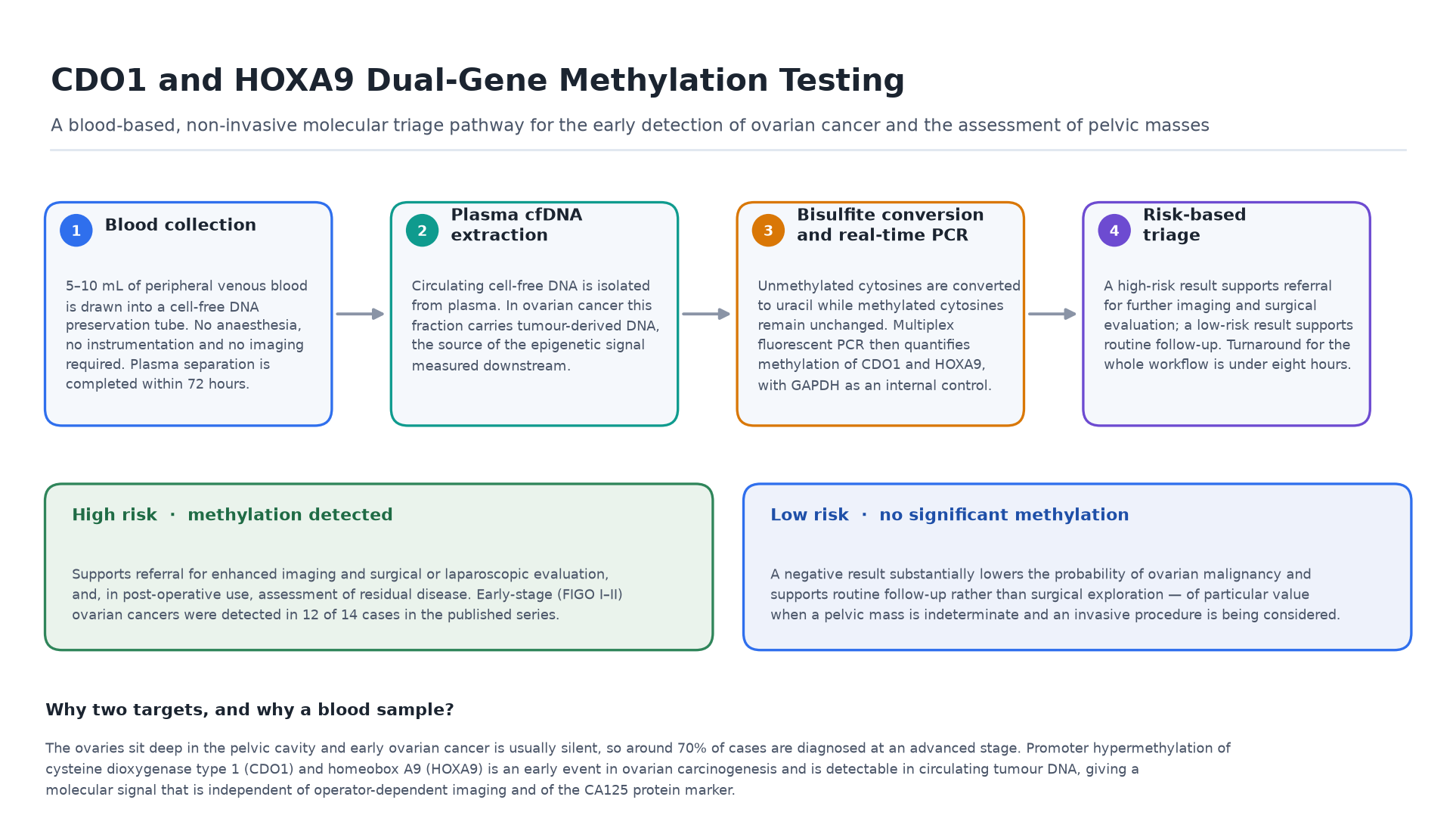
- A blood test, not an imaging examination. The assay runs on 5–10 mL of peripheral venous blood. No anaesthesia, no instrumentation and no operator-dependent ultrasound interpretation is required, and the complete workflow takes under eight hours.
- Two molecular targets, one objective result. It quantifies promoter methylation of CDO1 and HOXA9, an epigenetic signal that reflects malignant transformation rather than the presence of a protein marker.
- Diagnostic performance above 87%. Sensitivity 87.8%–93.2% and specificity 90.2%–97.5% across clinical, prospective and registration datasets; area under the curve up to 0.936 for the dual-gene combination.
- Early-stage detection. 12 of 14 FIGO stage I–II ovarian cancers were positive, and 80.0% of early-stage cancers were detected in the prospective cohort — a higher early-stage detection rate than CA125 in the same population.
- CE-marked and clinically registered. A signed CE Declaration of Conformity under the European In Vitro Diagnostic Medical Devices Directive (98/79/EC) is held, together with Class III in vitro diagnostic registration.
- The only commercially available product of its kind. No other CE-marked commercial real-time PCR kit detects ovarian cancer through CDO1 and HOXA9 promoter methylation, and this is the first ovarian cancer methylation detection product to be approved for clinical use.
The clinical problem: ovarian cancer still evades early detection
Ovarian cancer is the most lethal gynaecological malignancy. Because the ovaries lie deep within the pelvic cavity, early lesions produce no reliable symptoms, and the most frequently reported early complaints — abdominal bloating, pelvic or abdominal pain, early satiety, urinary frequency — are entirely non-specific. The consequence is a diagnostic delay that has proved stubbornly resistant to improvement: about two-thirds of women with epithelial ovarian cancer are diagnosed at an advanced stage, and five-year survival collapses from over 90% in early-stage disease to 30–40% in advanced disease.
The tools available for non-invasive assessment each carry a structural weakness. Transvaginal ultrasound is the first-line imaging modality, but its performance depends heavily on operator experience and it performs poorly as a discriminator between benign and malignant pelvic masses. CA125, the standard serum marker, lacks specificity and is elevated in many benign and malignant conditions; it is raised in only a minority of early-stage ovarian cancers, which is precisely the population in which a test would matter most. The ROMA index, which combines CA125, HE4 and menopausal status, improves on CA125 alone but does not resolve the underlying limitation.
Formal guidance now reflects this. The 2025 Chinese expert consensus on early screening for ovarian cancer states that CA125 combined with synchronous transvaginal ultrasound, and CA125-based ROCA index combined with sequential transvaginal ultrasound, are not recommended for early screening of asymptomatic average-risk women (evidence level I, recommendation strength E), citing the PLCO trial in which 78,216 women were randomised to annual CA125 plus ultrasound or to usual care: incidence (0.54% vs 0.45%), the proportion of early-stage disease (0.12% vs 0.10%) and ovarian cancer mortality (0.30% vs 0.26%) were statistically indistinguishable after a median 12.4 years of follow-up.
A different class of biomarker is therefore required — one that is molecular rather than morphological, quantitative rather than interpretive, and accessible from a routine blood draw.
Why CDO1 and HOXA9: the biology of a blood-based signal
Tumours shed DNA into the bloodstream. In women with ovarian cancer, the concentration of circulating cell-free DNA (cfDNA) is higher than in healthy women, and that fraction carries the genetic and epigenetic alterations of the primary tumour. Aberrant promoter hypermethylation of tumour-suppressor genes is one of the earliest detectable events in carcinogenesis, and it precedes changes in gene expression and any morphological abnormality visible on imaging. That makes cfDNA methylation an unusually attractive target for early detection.
HOXA9 encodes a homeobox transcription factor that governs differentiation; its promoter methylation is closely associated with the serous papillary histological subtype, the most common and most aggressive form of epithelial ovarian cancer. CDO1 encodes cysteine dioxygenase type 1, an enzyme involved in cysteine metabolism and redox regulation whose promoter silencing has been repeatedly documented across solid tumours, including ovarian cancer. Both targets have been independently validated in serum or plasma cfDNA by other research groups, giving the two-gene panel a mechanistic and epidemiological foundation rather than a purely empirical one.
Because the signal is epigenetic and quantitative, it is unaffected by the subjectivity that limits ultrasound interpretation, and it does not depend on the CA125 protein being shed — a decisive advantage in the substantial proportion of early-stage tumours that never raise CA125.
Diagnostic performance: what the evidence shows
Three independent bodies of data describe the assay's performance for ovarian cancer detection. All used histopathology as the gold standard.
| Data source | n | Sensitivity | Specificity | AUC |
|---|---|---|---|---|
| Case–control cohort, Southwest China (women with surgical indication for an ovarian mass; 122 benign, 29 ovarian cancer) | 151 | 89.7% (95% CI 73.6–96.4) | 97.5% (95% CI 93.0–99.2) | 0.936 (95% CI 0.878–0.994) |
| Prospective cohort, tertiary referral centre (90 ovarian cancers, 51 benign masses) | 141 | 87.8% | 90.2% | — |
| Registration clinical dataset (Class III in vitro diagnostic registration) | — | 93.19% | 92.78% | — |
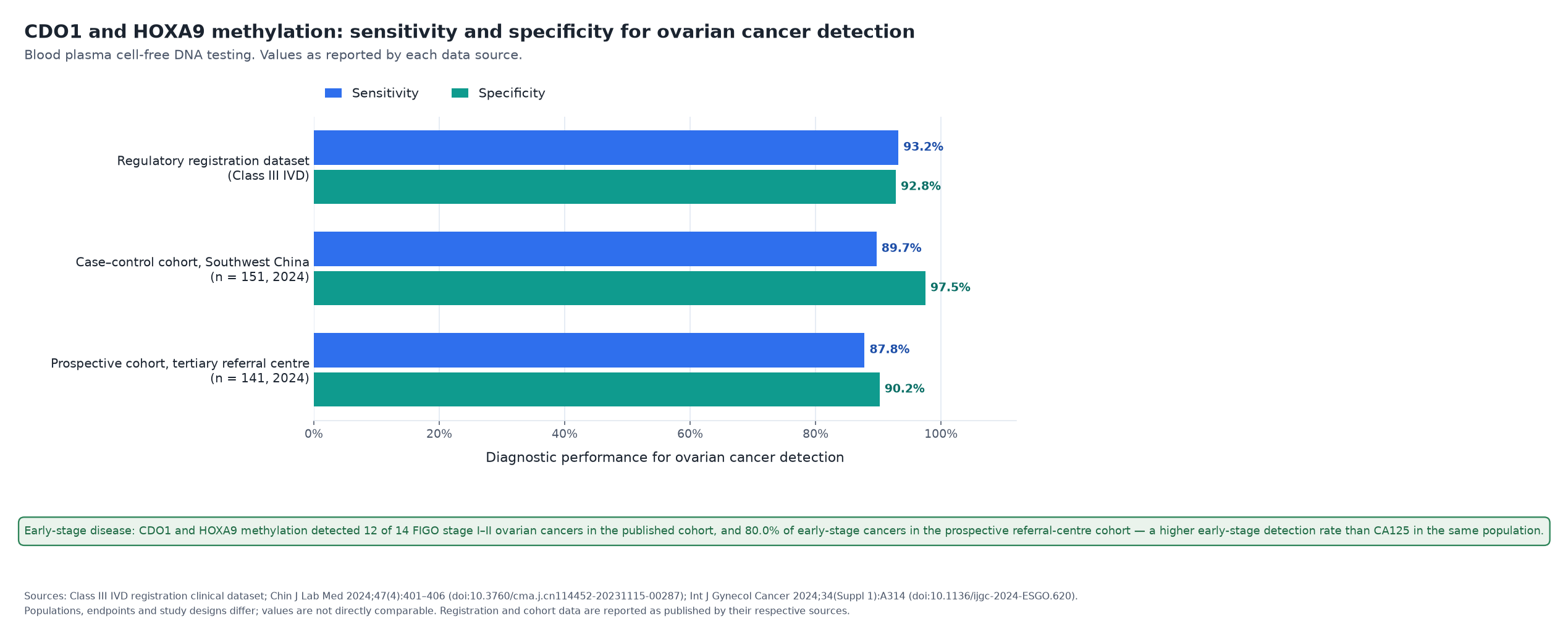
Three points merit emphasis. First, in the 151-woman case–control cohort, the dual-gene assay produced the highest area under the curve of any diagnostic approach evaluated — 0.936 (95% CI 0.878–0.994) — ahead of CA125, HE4, the ROMA index and transvaginal ultrasound, with a specificity of 97.5% against a benign-comparator group of 122 women. Second, early-stage detection was not sacrificed: 12 of 14 FIGO stage I–II ovarian cancers tested positive, a materially higher early-stage yield than CA125 in the same study. Third, the prospective referral-centre cohort reproduced the finding independently, at 87.8% sensitivity and 90.2% specificity, and reported that 80.0% of early-stage cancers were identified, again exceeding CA125.
Registration performance data add a third consistent dataset: overall sensitivity 93.19%, specificity 92.78%, positive predictive value 82.60% and negative predictive value 97.37%, rising to 94.29% sensitivity and 99.38% negative predictive value for stage I ovarian cancer.
CE marking, clinical registration and market availability
The assay is supplied as a commercial in vitro diagnostic kit — not as a laboratory-developed test — and carries the regulatory documentation appropriate to clinical use.
CE marking. A signed CE Declaration of Conformity has been issued under the European In Vitro Diagnostic Medical Devices Directive (98/79/EC), following the Annex III conformity assessment procedure, and the product has been notified for the European market through a European Authorised Representative. The declaration references the applicable harmonised European standards, including EN ISO 14971 for risk management, EN ISO 18113-1 and EN ISO 18113-2 for labelling of in vitro diagnostic devices, and EN 13612 for performance evaluation of in vitro diagnostic medical devices.
Clinical registration. The product has also received Class III in vitro diagnostic device registration — the highest risk class for in vitro diagnostics in that jurisdiction, reserved for devices where an erroneous result carries serious consequences — following prospective clinical evaluation against histopathology as the reference standard. To the manufacturer's knowledge, it is the first ovarian cancer methylation detection product to be approved for clinical use.
Only commercially available option of its kind. A peer-reviewed 2024 compendium of commercially available DNA methylation-based tests in oncology with CE-IVD certification catalogues the CE-marked methylation assays across lung, colorectal, glioblastoma, cervical, oral, bladder, hepatocellular, oesophageal, breast and multi-cancer indications — and lists no ovarian cancer methylation assay. To the manufacturer's knowledge, no other CE-marked commercial real-time PCR kit detects ovarian cancer through CDO1 and HOXA9 promoter methylation, which makes this the only commercial product of its kind currently available. Independent distributors in Europe already list the assay for clinical laboratory use.
Clinical scenarios and target populations
1. Women presenting with a pelvic mass of uncertain nature. This is the highest-value use case. Distinguishing a benign ovarian cyst from malignancy before surgery is genuinely difficult with imaging alone, and the consequence of getting it wrong runs in both directions — unnecessary surgery on one hand, delayed oncological referral on the other. Against a comparator group of 122 women with benign pathology, the assay achieved 97.5% specificity, meaning it classified benign masses correctly in the great majority of cases.
2. Women with suspicious symptoms but unremarkable imaging. Non-specific abdominal bloating, pelvic pain, early satiety and urinary frequency are common and usually benign, yet they are also the presenting complaints of ovarian cancer. A blood-based molecular test provides an objective second signal when ultrasound is equivocal — precisely the situation in which ultrasound performs least well.
3. Women at elevated risk. Carriers of BRCA1 or BRCA2 mutations, women with a family history of ovarian, breast or related tumours, and women who are nulliparous or had late first childbirth carry substantially increased lifetime risk and require intensified surveillance, alongside the option of risk-reducing surgery.
4. Postmenopausal women with new pelvic symptoms. Because CA125 is less often elevated in early-stage disease and ultrasound interpretation is less reliable after menopause, this group benefits disproportionately from a marker that does not depend on either.
5. Post-treatment surveillance and prognosis. Because the assay detects tumour-derived methylation in blood, it can be applied after treatment: in a post-operative setting the result is described as indicating whether ovarian cancer appears to have metastasised, with a high-risk result prompting further examination and a low-risk result supporting routine follow-up. The same approach is being applied in a prospective multicentre study of cfDNA methylation for epithelial ovarian cancer, with more than ten centres and a recruitment target above 5,000 participants, to define its value in real-world early detection and prognosis follow-up.
Clinical value: replacing an invasive default with a blood test
The economic and human argument follows directly from the diagnostic gap. Ovarian cancer has no recommended non-invasive screening test for average-risk women, so assessment of a suspicious pelvis proceeds through imaging, then increasingly through laparoscopy or laparotomy. A test that requires only a blood draw, that returns a defined high-risk or low-risk result, and that carries a negative predictive value of 97.37% overall and 99.38% for stage I disease can reduce the number of women taken to surgery for ultimately benign findings, shorten the interval to oncological referral for those who do have cancer, and provide a repeatable molecular readout for follow-up after treatment.
Two design features support that role. First, the assay is compatible with widely used real-time PCR platforms and requires no bespoke instrumentation, so it can be adopted by existing molecular diagnostic laboratories rather than requiring capital investment. Second, its analytical performance has been characterised against formal acceptance criteria: in three consecutive production batches, precision across intra-batch, inter-batch, inter-day and inter-operator evaluations kept the coefficient of variation of Ct values within 5%; the limit of detection was established at 50 ng of DNA with 5% methylation per target; six clinical negative samples tested negative across all batches; and cross-reactivity testing showed no interference from haemoglobin at 2 g/L, triglycerides at 37 mmol/L or K2EDTA at 11 mg/mL. Kit stability is specified at −20 °C for up to 12 months.
Appropriate use and honest limitations
Responsible communication requires stating what the assay is and is not.
It is an adjunctive diagnostic test, not a screening programme. The intended use is clinical auxiliary diagnosis of patients with suspected ovarian cancer. A positive result should not be used to confirm a diagnosis of ovarian cancer; a negative result does not exclude it and should not be the sole basis for patient management. The test is not intended for tumour screening in the general population, and the 2025 consensus concludes that average-risk asymptomatic women should not undergo ovarian cancer screening at all.
Positive predictive value is modest in low-prevalence settings. The registration dataset reports a PPV of 82.60%, but PPV is inherently prevalence-dependent and will fall where malignancy is uncommon. This is why the test is best used to rule out and to stratify, in combination with clinical assessment and imaging, rather than as a stand-alone rule-in test.
Evidence base and endpoint heterogeneity. The published clinical cohorts comprise 151 and 141 women with histologically confirmed diagnoses — substantial for a molecular diagnostic study but smaller than the populations in which a screening claim would need to be made, and enriched for women already referred for surgery. Sensitivity and specificity are therefore reported for a high-prevalence, referral-based population and will differ in lower-prevalence settings. The three datasets also differ in design, geography and comparator group, so figures are not directly comparable; the larger multicentre study is ongoing.
Pre-analytical discipline matters. Performance depends on correct specimen handling: samples require a cell-free DNA preservation tube and plasma separation within a defined window, and the reported analytical performance assumes standardised extraction, bisulfite conversion and real-time PCR conditions. Laboratories adopting the assay must validate their own workflow before clinical reporting, and the test is intended for use by qualified laboratory personnel trained in real-time PCR and in vitro diagnostic procedures.
Frequently asked questions
What exactly does the CDO1 and HOXA9 methylation test measure? It measures the level of DNA methylation at the promoter regions of the CDO1 and HOXA9 genes in circulating cell-free DNA extracted from plasma, using multiplex fluorescent real-time PCR with GAPDH as an internal control. Elevated methylation indicates an increased likelihood of ovarian cancer.
What sample is required? A peripheral venous blood sample of 5–10 mL, collected into a cell-free DNA preservation tube. Plasma must be separated within 72 hours; the sample should not be frozen or stored between 0 and 6 °C before processing.
How does it compare with CA125? CA125 is a protein marker with limited specificity, and it is elevated in only a minority of early-stage ovarian cancers. In the published cohort, the methylation assay achieved the highest area under the curve of all methods assessed — 0.936 — and detected a higher proportion of early-stage cancers than CA125 in the same population. The two are complementary rather than mutually exclusive.
Does it replace transvaginal ultrasound? No. It addresses a different question and is described in the literature as an adjunct and triage tool. Its value is greatest where ultrasound is equivocal, where the mass is of uncertain nature, or where operative decisions are being considered.
How long does the test take? The complete workflow — DNA extraction, bisulfite conversion, real-time PCR and result interpretation — takes under eight hours.
Is it available outside China? Yes. The assay is CE-marked for the European market and distributed for clinical laboratory use internationally.
Which patients should be tested? Women with a pelvic mass of uncertain nature, women with suspicious symptoms and equivocal imaging, women at elevated genetic or familial risk, and postmenopausal women with new pelvic symptoms. It is not intended for general-population screening of asymptomatic average-risk women.
Evidence base: peer-reviewed and regulatory references
- [1] Hou Q, Yuan Y, Li Y, et al. The significance of hypermethylation level of CDO1 gene and HOXA9 gene in serum in the diagnosis of ovarian cancer. Chin J Lab Med. 2024;47(4):401–406. doi:10.3760/cma.j.cn114452-20231115-00287.
- [2] Li L, Chao X, Kong L, et al. The significance of detecting hypermethylation levels of CDO1 and HOXA9 in serum for early diagnosis of ovarian cancer. Int J Gynecol Cancer. 2024;34(Suppl 1):A314. doi:10.1136/ijgc-2024-ESGO.620.
- [3] Singh A, Gupta S, Sachan M. Detection of aberrant methylation of HOXA9 and HIC1 through multiplex MethyLight assay in serum DNA for the early detection of epithelial ovarian cancer. Int J Cancer. 2020. PMID 32191343.
- [4] Singh A, Gupta S, Sachan M. Evaluation of the diagnostic potential of candidate hypermethylated genes in epithelial ovarian cancer in North Indian population. Front Mol Biosci. 2021. PMID 34778370.
- [5] Chinese Society of Obstetrics and Gynaecology, et al. Chinese expert consensus on early screening for ovarian cancer (2025 edition). Chin J Pract Gynecol Obstet. 2025;41(2). doi:10.19538/j.fk2025020113.
- [6] Baranova I, Samec M, Pecova R, et al. DNA methylation biomarkers in cancer diagnostics — compendium of commercially available CE-IVD methylation tests in oncology. Acta Medica Martiniana. 2024;24(1):1–6. doi:10.2478/acm-2024-0001.
- [7] ctDNA methylation for epithelial ovarian cancer (OVAMethy study). ClinicalTrials.gov identifier NCT05801263.
- [8] Beijing Municipal Science & Technology Commission, Science and Technology Achievement Information System. Development and clinical validation of an ovarian cancer early screening product based on methylation detection — registration clinical performance dataset. Available at: https://www.ncsti.gov.cn/kcfw/zcg/kjcgxxxt/cgxq/?id=16672
A note on this release
All quantitative statements above are drawn from the peer-reviewed publications, clinical trial registrations and regulatory datasets listed in the reference section, and are reported as published by their authors or issuing bodies, including confidence intervals where available. Independent regulatory documentation — the signed CE Declaration of Conformity and the associated European notification — is held by the manufacturer and available for verification through normal supplier qualification channels. Datasets differ in study design, population, geography and comparator group, so individual figures are not directly comparable across rows. Statements of market uniqueness are made on the basis of the published CE-IVD methylation test compendium and the manufacturer's knowledge of the current competitive landscape at the time of writing. This release describes the scientific, clinical and regulatory basis of CDO1 and HOXA9 dual-gene methylation testing as a methodology; it deliberately contains no manufacturer or brand identifiers. Ovarian cancer assessment and any decision to refer a patient for surgery should always follow local clinical guidelines and the judgement of the treating clinician.
Related reading: DNA methylation testing across oncology indications
This article is part of a series on the clinical use of DNA methylation testing. The other articles in the series, and the product page corresponding to the technology described in this article, are listed below.
- Cervical cancer: PAX1 and JAM3 dual-gene methylation testing for cervical cancer triage and the management of HPV-positive women
- Endometrial cancer: CDO1 and CELF4 dual-gene methylation testing for endometrial cancer in women with abnormal uterine bleeding
- Lung cancer: SHOX2 and RASSF1A DNA methylation PCR kit for the molecular triage of indeterminate lung lesions
- Colorectal cancer: Methylated SEPT9 DNA blood test for colorectal cancer screening and pre-colonoscopy triage
Related product: Human CDO1 and HOXA9 Gene Methylation Detection Kit (Real-Time PCR)