September 29, 2026
PAX1 and JAM3 Dual-Gene Methylation Testing: A Precision Triage Pathway for Cervical Cancer Screening
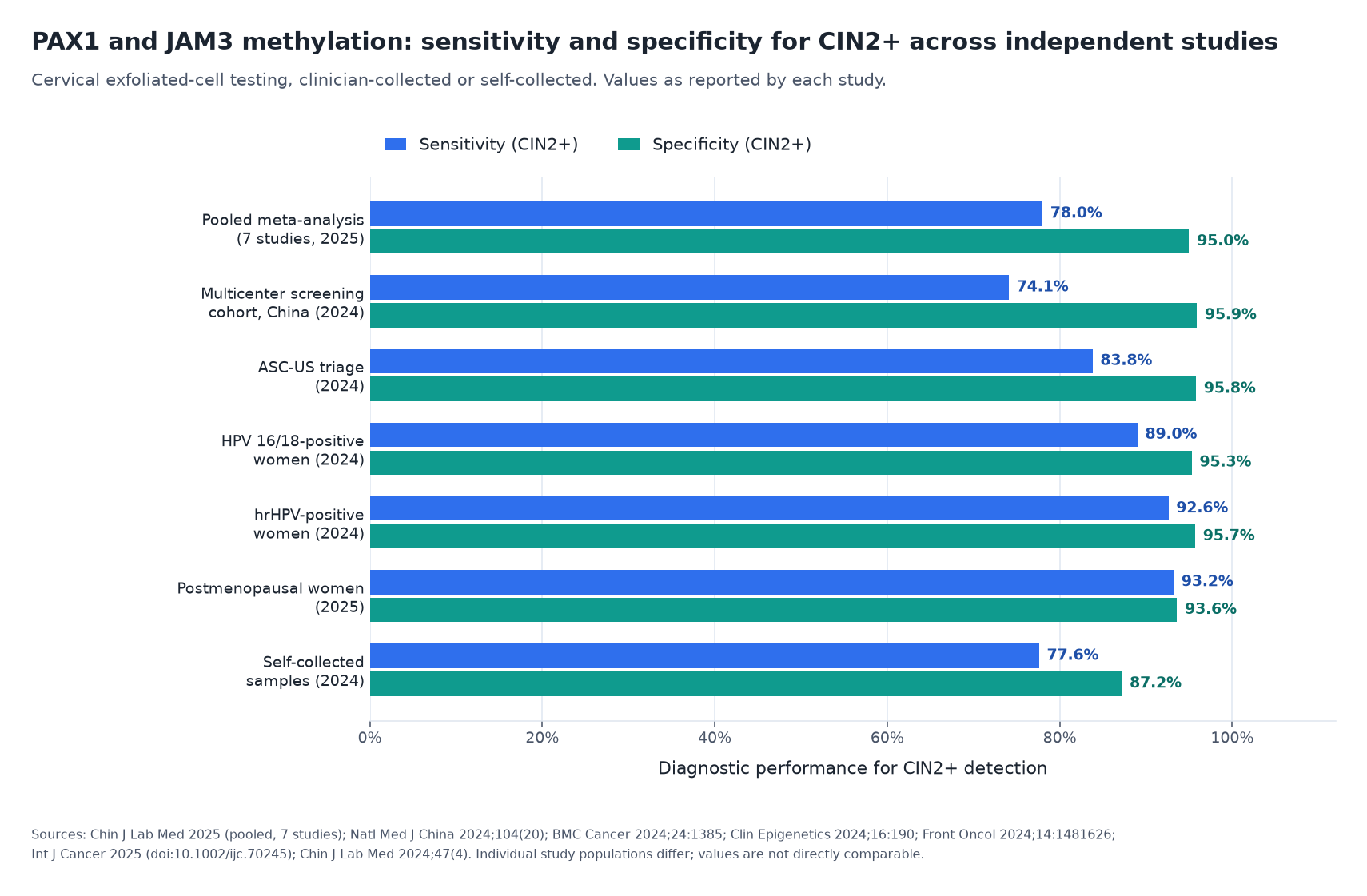
Summary — A DNA methylation test that measures two gene targets, PAX1 (paired box gene 1) and JAM3 (junctional adhesion molecule 3), in cervical exfoliated cells is rapidly establishing itself as an objective, molecular triage tool for cervical cancer prevention. Across more than a dozen peer-reviewed clinical studies — including multicenter prospective cohorts enrolling several thousand women — PAX1 and JAM3 methylation testing has consistently delivered CIN2+ sensitivity of roughly 74%–93% and specificity of roughly 87%–96%, outperforming liquid-based cytology in the same populations. Because the assay is quantitative and does not depend on subjective microscopy, it helps clinicians separate women with genuine high-grade precancer from the large majority whose human papillomavirus (HPV) infection is transient — reducing unnecessary colposcopy referrals by as much as 79.5% in published series while missing almost no cancers.
Key takeaways
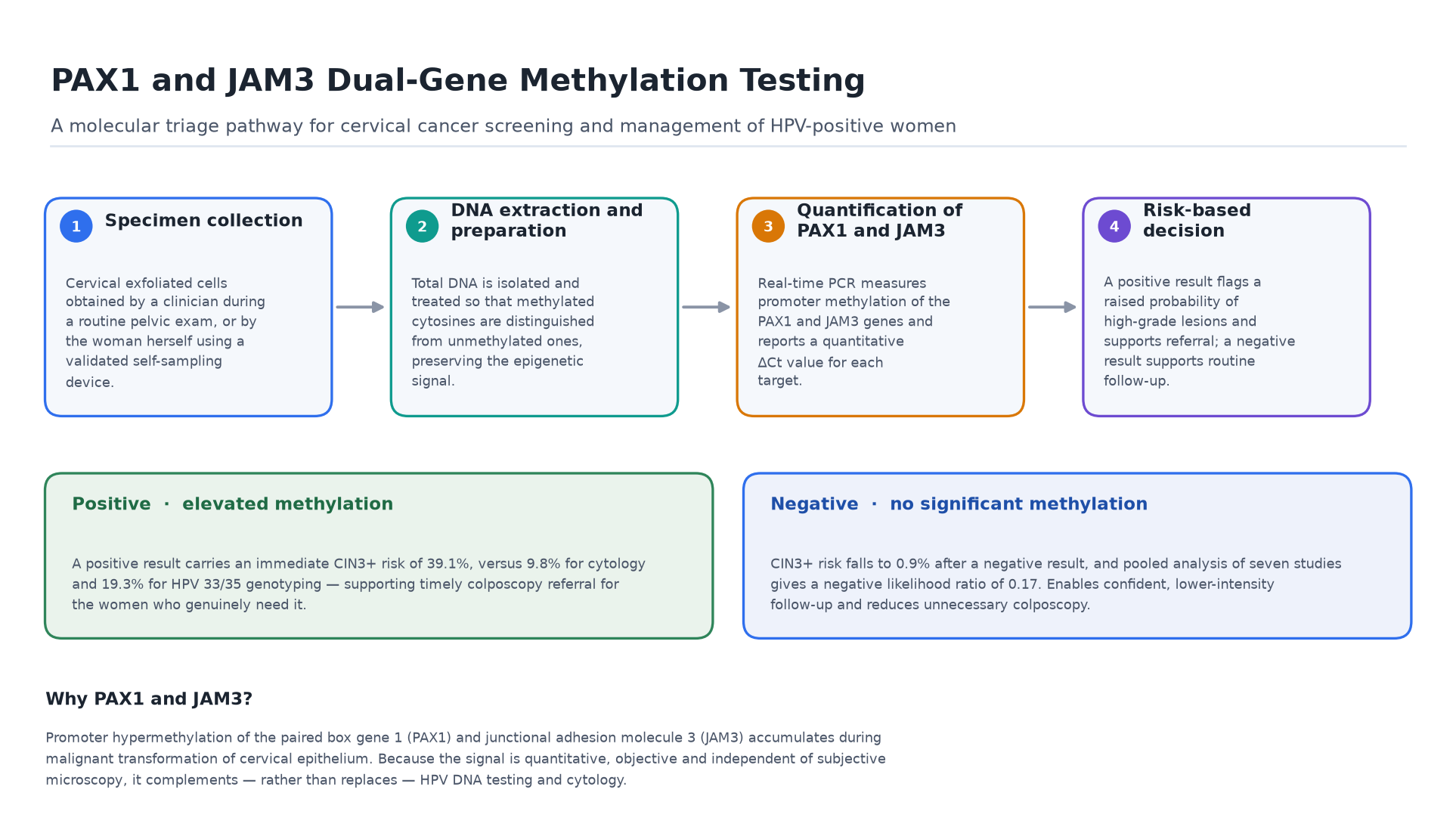
- Two targets, one objective result. The assay reads the methylation status of the PAX1 and JAM3 promoters and returns a quantitative score, avoiding the inter-observer variability that limits cervical cytology.
- High specificity where it matters most. In HPV-positive women, specificity is consistently in the 88%–96% range, which is the property that removes unnecessary colposcopies.
- Sensitivity retained, referrals reduced. Sensitivity for CIN2+ is comparable to cytology, yet referral rates fall by 57%–79.5% in the largest prospective studies.
- Works across difficult populations. Evidence now covers non-16/18 HPV genotypes, HPV 16/18 positives, ASC-US cytology, women aged 50 and over, and self-collected samples.
- Standardised and consensus-endorsed. A five-society Chinese expert consensus published in 2025 defines the laboratory workflow, quality control and reporting standards for PAX1/JAM3 methylation testing.
Why PAX1 and JAM3? The biology behind the test
Cervical cancer develops through a well-characterised sequence of precancerous stages — cervical intraepithelial neoplasia grades 1, 2 and 3 (CIN1, CIN2, CIN3) — before invasive disease appears. Most HPV infections, however, are transient: more than 80% of women acquire a cervical HPV infection during their lifetime and roughly 90% of those infections clear spontaneously. The clinical problem with HPV DNA testing as a stand-alone screen is therefore not a lack of sensitivity but an excess of signals — it identifies infection, not transformation.
DNA methylation fills that gap. During malignant transformation, specific gene promoters acquire abnormal cytosine methylation, silencing tumour-suppressor activity. Two such markers are especially well validated in cervical carcinogenesis: PAX1, a paired box transcription factor involved in developmental regulation of cervical epithelium, and JAM3, a junctional adhesion molecule that contributes to epithelial cell–cell cohesion. Hypermethylation of the PAX1 and JAM3 promoters accumulates as lesions advance, which is why methylation levels rise progressively from normal tissue through CIN1, CIN2 and CIN3 to invasive cancer.
Because this epigenetic signal is a direct by-product of the transforming process rather than a proxy for viral presence, it answers a different question from HPV DNA testing: not “is the virus there?” but “is the epithelium changing?” That distinction is what makes a two-gene methylation assay a natural triage test — a second-stage filter applied to women who already test positive on a primary screen.
Diagnostic performance: what the evidence shows
Pooled evidence and individual prospective cohorts converge on a consistent picture. A meta-analysis of seven diagnostic studies found that combined PAX1 and JAM3 methylation testing achieved a pooled CIN2+ sensitivity of 0.78 (95% CI 0.75–0.80) with a pooled specificity of 0.95 (95% CI 0.94–0.95), a positive likelihood ratio of 14.61 and a diagnostic odds ratio of 77.36; the pooled area under the curve was 0.9694. For the more stringent CIN3+ endpoint, pooled sensitivity was 0.84 (95% CI 0.80–0.87), specificity 0.87 (95% CI 0.86–0.88), negative likelihood ratio 0.17 and area under the curve 0.9251.
| Study population | Endpoint | Sensitivity | Specificity | Source |
|---|---|---|---|---|
| Pooled meta-analysis, 7 studies | CIN2+ | 78% | 95% | Xiao et al., 2025 |
| Pooled meta-analysis, 7 studies | CIN3+ | 84% | 87% | Xiao et al., 2025 |
| Multicenter screening cohort, China (n=1,184) | CIN2+ / CIN3+ | 74.1% / 87.6% | 95.9% / 86.8% | Shang et al., 2024 |
| Non-16/18 hrHPV-positive women (n=1,851) | CIN3+ | 84.8% | 88.5% | Chen et al., 2024 |
| ASC-US cytology (n=322) | CIN2+ | 83.8% | 95.8% | Chen et al., 2024 |
| HPV 16/18-positive women (n=334) | CIN2+ | 89.0% | 95.3% | Fei et al., 2024 |
| hrHPV-positive women (n=436) | CIN2+ | 92.6% | 95.7% | Liang et al., 2024 |
| Postmenopausal women aged ≥50 (n=216) | CIN2+ / CIN3+ | 93.2% / 97.2% | 93.6% | Peng et al., 2025 |
| Self-collected vaginal samples (n=272) | CIN2+ / CIN3+ | 77.6% / 96.0% | 87.2% | Yu et al., 2024 |
| HR-HPV-infected women (n=808) | Cervical cancer | 86.3% | 91.0% | Feng et al., 2025 |
Two findings recur across these cohorts and deserve emphasis. First, in the 1,184-woman multicenter study, PAX1/JAM3 methylation achieved an area under the curve of 0.872 (95% CI 0.847–0.897) for CIN3+, against 0.580 for cytology and 0.503 for hrHPV testing in the same cohort. Second, in the 1,851-woman non-16/18 cohort, the assay detected all 20 cervical cancers in the study, and its odds ratio for CIN3+ was 42.6 (95% CI 27.1–69.6) versus 3.3 (95% CI 2.0–5.9) for cytology.
Clinical scenarios and target populations
1. Triage of HPV-positive women (the core use case). Current guidelines refer HPV 16/18-positive women directly to colposcopy and route non-16/18 positives through cytology. In a multicenter prospective study of 1,851 non-16/18 hrHPV-positive women, PAX1/JAM3 methylation outperformed cytology and reduced the proportion of women needing colposcopy from 74.66% to 17.45% — a 57.21% reduction in referral volume without compromising diagnostic sensitivity. In a separate analysis of non-16/18 hrHPV infections, a positive methylation result corresponded to an immediate CIN3+ risk of 39.1%, compared with 9.8% for cytology and 19.3% for HPV 33/35 genotyping; a negative result lowered CIN3+ risk to 0.9%.
2. Managing ASC-US — the most common equivocal cytology result. ASC-US is the diagnostic grey zone in which clinicians risk both under- and over-treatment. In a study of 322 women with ASC-US, the methylation assay achieved 83.8% sensitivity and 95.8% specificity for CIN2+, and reduced the colposcopy referral rate among high-risk HPV-positive women by 79.5%.
3. HPV 16/18-positive women. Although guidelines already send these women to colposcopy, not all harbour high-grade disease. Among 334 HPV 16/18-positive women, methylation testing delivered 89.0% sensitivity and 95.3% specificity for CIN2+, with an area under the curve of 0.921 and an odds ratio of 164.02 — identifying every cancer patient and, in women aged 30 and above, missing no CIN3+ case. On average, 1.12 referrals were required to detect one CIN2+ lesion.
4. Women aged 50 and over. Postmenopausal cervical screening is difficult: the transformation zone recedes, cytology sensitivity falls, and colposcopy is less informative. In a study of 216 postmenopausal women referred for colposcopy, methylation testing reached 93.2% sensitivity for CIN2+ (97.2% for CIN3+) and 93.6% specificity, comfortably exceeding liquid-based cytology (75% sensitivity, 52.3% specificity) and cytology-plus-hrHPV testing. It also identified two adenocarcinoma cases that were negative on both hrHPV and cytology.
5. Self-collection and hard-to-reach populations. Self-sampling is central to the World Health Organization's strategy for reaching women who do not attend clinic-based screening. In 272 women with paired self-collected and clinician-collected samples, methylation results from self-samples correlated strongly with clinician samples and achieved 96.0% sensitivity for CIN3+ — better than hrHPV testing (92.0%) and cytology (82.6%) in the same group. Methylation testing is therefore a plausible triage option precisely where cytology cannot be performed.
6. Beyond triage: prognosis and surveillance. Emerging applications include predicting pathological upgrading of CIN before conization (area under the curve 0.818, with a PAX1 ΔCt cut-off of 4.34) and predicting recurrence after treatment of high-grade lesions, where recurrent patients show significantly higher methylation levels than those cured.
Clinical value: fewer unnecessary colposcopies, more cancers found
The economic and human case for methylation triage rests on a single structural weakness in current screening: HPV DNA testing is very sensitive but not very specific, so it generates large numbers of positive results in women who will never develop cancer. Every one of those results triggers anxiety, a colposcopy appointment, and in some cases unnecessary treatment with associated obstetric risk.
Reported figures are striking. Referral rate reductions of 57.21% (non-16/18 hrHPV), 79.5% (ASC-US with high-risk HPV) and a drop from 80.70% to 43.94% versus cytology in an 808-woman HR-HPV cohort all point the same way. Pooled negative likelihood ratios of 0.17–0.20 for CIN2+ and CIN3+ mean that a negative methylation result substantially lowers the probability of significant disease — the property that makes safe de-escalation of follow-up possible. At the same time, the assay did not trade away safety: it identified all 20 cancers in the 1,851-woman cohort, and all cancers including two HPV-negative adenocarcinomas in the 436-woman cohort.
A 2026 independent systematic review and meta-analysis of DNA methylation markers in 28,977 HPV-positive women placed JAM3 (diagnostic odds ratio 20.82, 95% CI 14.41–30.08) and PAX1 (17.13, 95% CI 9.20–31.89) among the highest-performing individual methylation markers for CIN2+ detection, confirming that the strength of the two-gene combination rests on two independently robust biomarkers.
Appropriate use and honest limitations
Responsible communication requires stating what the evidence does and does not yet show.
PAX1/JAM3 methylation testing is a triage and supplementary tool, not a replacement for primary HPV screening or for diagnostic histology. A positive methylation result indicates elevated risk and supports referral; it is not a cancer diagnosis, which still requires colposcopy and biopsy. Conversely, a negative result meaningfully lowers but does not abolish risk, so follow-up intervals must follow local guidelines. Pooled sensitivity for CIN2+ sits around 0.78, which is lower than the sensitivity of cytology at the ASC-US threshold in some cohorts — the gain is in specificity and in referral efficiency, not in raw case detection. Published cohorts, while large and increasingly prospective, are drawn predominantly from Chinese hospital and opportunistic-screening settings; performance in population-based programmes with different HPV genotype distributions and vaccination coverage requires further prospective validation. Finally, the 2025 expert consensus explicitly frames standardised laboratory workflow, quality control and reporting as prerequisites for clinical use, since assay performance depends on pre-analytical handling and consistent ΔCt interpretation.
Frequently asked questions
What exactly does the PAX1/JAM3 methylation test measure? It measures the level of DNA methylation at the promoter regions of the PAX1 and JAM3 genes in cervical exfoliated cells, reported as a quantitative ΔCt value for each target. Rising methylation indicates increasing likelihood of high-grade precancerous change.
How is the sample collected? Cervical exfoliated cells are collected either by a clinician during a routine pelvic examination, using the same liquid-based medium as cytology, or by the woman herself using a validated self-sampling device. Self-collected and clinician-collected results have shown strong concordance.
Is it better than the HPV test? It is complementary rather than competing. HPV testing is highly sensitive for infection; methylation testing is more specific for transformation. Used together — HPV as the primary screen, methylation as the triage — the combination keeps sensitivity high while cutting unnecessary colposcopy.
Which women benefit most? HPV-positive women (especially non-16/18 genotypes), women with ASC-US cytology, women aged 50 and over, and women who prefer or require self-collection.
Evidence base: peer-reviewed references
- [1] Shang X, Kong L, Xiao X, et al. A multicenter study on the accuracy of PAX1/JAM3 dual genes methylation testing for screening cervical cancer. Natl Med J China. 2024;104(20):1852–1859. doi:10.3760/cma.j.cn12137-20231004-00630 (PMID 38782754).
- [2] Chen X, Jin X, Kong L, et al. Triage performance of PAX1m/JAM3m in opportunistic cervical cancer screening of non-16/18 human papillomavirus-positive women: a multicenter prospective study in China. Clin Epigenetics. 2024;16:108. doi:10.1186/s13148-024-01731-w.
- [3] Chen X, Jiang H, Xu H, et al. Cervical cancer screening: efficacy of PAX1 and JAM3 methylation assay in the triage of atypical squamous cell of undetermined significance (ASC-US). BMC Cancer. 2024;24:1385. doi:10.1186/s12885-024-13082-z (PMID 39528979).
- [4] Fei J, Zhai L, Wang J, et al. Evaluating PAX1/JAM3 methylation for triage in HPV 16/18-infected women. Clin Epigenetics. 2024;16:190. doi:10.1186/s13148-024-01804-w (PMID 39726021).
- [5] Liang H, Liu Y, Yin S, et al. Assessment of PAX1 and JAM3 methylation triage efficacy across HPV genotypes and age groups in high-risk HPV-positive women in China. Front Oncol. 2024;14:1481626. doi:10.3389/fonc.2024.1481626 (PMID 39659794).
- [6] Sun D, Shu C, Zeng F, et al. The performance of JAM3/PAX1 methylation in the diagnosis of high-grade squamous intraepithelial lesions for women with high-risk HPV infection. BMC Cancer. 2024;24:1514. doi:10.1186/s12885-024-13299-y (PMID 39696066).
- [7] Peng H, Li J, Zhou Q, et al. Enhanced diagnostic accuracy of high-grade cervical intraepithelial neoplasia in postmenopausal women through PAX1/JAM3 methylation analysis. Int J Cancer. 2025. doi:10.1002/ijc.70245 (PMID 41239544).
- [8] Su H, Jin X, Kong L, et al. The triage role of cytological DNA methylation in women with non-16/18, specifically genotyping high-risk HPV infection. Br J Cancer. 2025. doi:10.1038/s41416-025-03005-5.
- [9] Yu F, Ma J, Zhou X, et al. Feasibility evaluation of using PAX1/JAM3 methylation markers as cervical cancer screening for female self-collected samples. Chin J Lab Med. 2024;47(4):419–427. doi:10.3760/cma.j.cn114452-20240109-00016.
- [10] Xiao J, Zhang X, Liu Y, et al. PAX1 and JAM3 methylation for the diagnosis of cervical high-grade intraepithelial neoplasia: a meta-analysis. 2025. doi:10.13283/j.cnki.xdfckjz.2025.09.004.
- [11] Li X, He S, Zhao X, et al. High-grade cervical lesions diagnosed by JAM3/PAX1 methylation in high-risk human papillomavirus-infected patients. J Cent South Univ (Med Sci). 2023;48(12). doi:10.11817/j.issn.1672-7347.2023.230175 (PMID 38448375).
- [12] Li L, et al. PAX1/JAM3 methylation and HPV viral load in women with persistent HPV infection. Cancers. 2024;16(7):1430. doi:10.3390/cancers16071430 (PMID 38611108).
- [13] Chen X, et al. The role of PAX1 and JAM3 methylation in predicting the pathological upgrading of cervical intraepithelial neoplasia before conization. Sci Rep. 2025. doi:10.1038/s41598-025-01422-3 (PMID 40399320).
- [14] Feng W, Zhai Y, Meng L, et al. The clinical value of PAX1/JAM3 gene methylation in cervical cancer diagnosis among women with HR-HPV infection. Labeled Immunoassays Clin Med. 2025. doi:10.11748/bjmy.issn.1006-1703.2025.10.008.
- [15] Lou Y, Liu Y, Zhao S, et al. A clinical study of DNA methylation of the JAM3 gene in predicting cervical high-grade intraepithelial neoplasia and postoperative recurrence. Adv Clin Med. 2024;14(7):1293–1299. doi:10.12677/acm.2024.1472146.
- [16] Luo, et al. PAX1/JAM3 methylation in cervical exfoliated cells: a robust diagnostic biomarker for cervical high-grade lesions associated with vaginal dysbiosis. BMC Womens Health. 2026;26:108. doi:10.1186/s12905-026-04285-6 (PMID 41572269).
- [17] Laboratory Medicine Committee of the Chinese Association of Integrative Medicine, Chinese Society of Laboratory Medicine, et al. Expert consensus on the workflow, report, and clinical applications of dual-gene methylation detection of PAX1 and JAM3 for cervical cancer. Chin J Lab Med. 2025;48(2). (PREPARE-2024CN740).
- [18] Diagnostic testing accuracy of DNA methylation tests for detection of high-grade cervical intraepithelial neoplasia and cervical cancer: a systematic review and meta-analysis. 2026. (PMID 42235467).
A note on this release
All quantitative statements above are drawn from the peer-reviewed publications listed in the reference section and are reported as published by their authors, including confidence intervals where available. Study populations differ in HPV genotype distribution, age range, cytology status and sampling method, so individual figures are not directly comparable across cohorts. This release describes the scientific and clinical evidence for PAX1 and JAM3 dual-gene methylation testing as a methodology; it deliberately contains no manufacturer or brand identifiers. Cervical cancer screening and any decision to refer a patient for colposcopy should always follow local clinical guidelines and the judgement of the treating clinician.
Related reading: DNA methylation testing across oncology indications
This article is part of a series on the clinical use of DNA methylation testing. The other articles in the series, and the product page corresponding to the technology described in this article, are listed below.
- Endometrial cancer: CDO1 and CELF4 dual-gene methylation testing for endometrial cancer in women with abnormal uterine bleeding
- Ovarian cancer: CDO1 and HOXA9 dual-gene methylation testing for ovarian cancer detection and pelvic mass triage
- Lung cancer: SHOX2 and RASSF1A DNA methylation PCR kit for the molecular triage of indeterminate lung lesions
- Colorectal cancer: Methylated SEPT9 DNA blood test for colorectal cancer screening and pre-colonoscopy triage
Related product: Human PAX1 and JAM3 Gene Methylation Detection Kit (Real-Time PCR)